

Joy in Nature’s Diversity
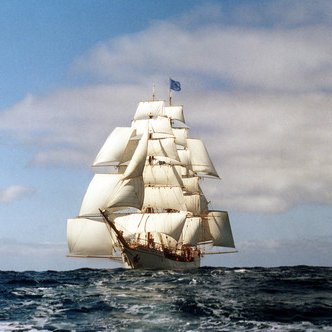

We sail with life all around us, but it requires that we pay attention and are able to recognise changes in life’s diversity as we traverse the South Pacific.
We live because of the biodiversity of nature; it brings us joy as well as sustenance. The photosynthesising plankton of the oceans give us oxygen and provide the basis of the ocean’s food web. While there is much we know about this, there is so much more we need to learn about the dynamics of these systems and how they are affected by our ever-changing environments.
On deck during our first days of sailing we saw whales blowing and surfacing, and in identifying them, we learn that the humpback whales around the Cook Islands tend to not show their tail flukes on their dives. Around Tonga the humpback whales again raise their tails and we hope for good photos so they can be identified by their fluke markings. One day about 750 nautical miles from Tonga, while we were looking out from the helm, up from the depths surfaced a minke whale within five meters of the boat. We let out screams of delight, and the whale stayed long enough nearby for all of us to run and see it as it slowly swam around the stern and went on its way. Such a gift that our paths crossed out here in the open ocean. No more whales were spotted until we saw distant blows with around 500 and then 300 nautical miles to go to Auckland. Dolphins were only seen one night on lookout, one day from Auckland.
We have watched the changes in the species and numbers of birds we’ve observed. In doing hour-long observations every day, there were several days of not seeing birds during these surveys, and only a few birds were seen throughout the day. Gradually we began to see more birds, and got better with identifications as amateur birders. The first was the Red-footed Booby, identified only because it rested on one of the yards and we could see its red feet. Then there were White-chinned Petrels, White-headed Petrels, Sooty Shearwaters, Brown Boobies, and Masked Boobies. There were lots of failed attempts at identification of birds too distant and those whizzing by in the winds. Three days after we crossed the Tropic of Capricorn we saw our first Wandering Albatross, which carried us all aloft with its soaring. One day of calm seas we watched as one of these majestic birds succeeded in its efforts to leave its resting place on the water as a breeze grew. As we continued south more and more birds appeared. In the last four days, we recorded 20–30 birds seen during the hour-long surveys, including new species of albatross and our first Giant Petrels.


So too, we observed changes in the plankton in the four tows we were able to do during lighter winds. Looking at the plankton under our two microscopes opened up a whole new world and brought fascination and awe about our oceans. Our first tow had a relatively sparse number of individuals but at least 27 different species were found. At the base of the food web were single-celled photosynthetic species, and some tiny branched algae, as well as many bright orange radiolarians with long projecting transparent spines that allow them to float. There were lots of small copepod crustaceans, including a beautiful brilliant blue species, others with orange-filled digestive systems, and some colourless species, all with delicate long antennae. Other crustaceans included small shrimp with big black bug eyes, little ostracods that are protected in their tiny clam-like shells, and several discarded exoskeletons of adult barnacles that made us wonder if they had come from growing barnacles on our hull. We found several types of egg masses, from possible copepod eggs and snail eggs to some larger fish eggs. A few molluscs were represented in the form of small snails, some with garden-snail-shaped shells and others with turban shapes. There were the larvae of a few different species of segmented worms, known as polychaete worms in the marine environment, some looking nothing like worms, and others with little legs or spines off each segment. One little worm was found sticking out of a transparent case with tentacles that had a series of red and white dots. Then even more startling was an unidentified species that looked a bit worm-like with orange and turquoise bands along its body and an orange collar below its head, which would occasionally poke out to feed, looking rather like a dugong with little black eyes. But what was crazy is that the orange collar had little cilia that were stirring the water, creating continuous bioluminescence while we watched it under the microscope. Each plankton tow we did featured different species and many more individuals as we travelled south. Our second tow was dominated by the orange radiolarians, copepods and eggs, along with new species of arrow worms, some marine fungi, and an odd-looking gelatinous species that looked like it had six blue trumpets extending from its body, and a tiny fish. Our third tow featured a single-celled bioluminescent, photosynthesising species, possibly a dinoflagellate, that floated on the surface and had been providing us with light shows at night. There were also several hydrozoans, which are related to jellyfish, that look like transparent, gelatinous sacs. Some new species included a brilliant emerald green little worm-like critter, some tiny jellyfish, crustacean amphipods with spiky black legs, and a species with tentacles that lived in a transparent funnel that looked like an ice cream cone. Our final tow was utterly different, as it was crammed full with what looked like jellyfish. These turned out to be invertebrates that are most closely related to us, as they are grouped within the Urochordata group, which is a branch of the Chordata phylum that includes all vertebrates. The species we found is in a group called the doliolids, which can either reproduce sexually or clone themselves asexually. If they reproduce sexually they produce a larva that looks like a tadpole and has a primitive spinal cord, thus making them our distant relatives. If they reproduce asexually, they can do so within days and form a large swarm in the open ocean, which we must have passed through.
From breath-taking whales to soaring seabirds and the wild world of plankton, we all witnessed and felt the joys of nature.