

Manta trawling
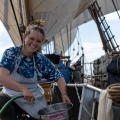

Deploying the manta trawl (named for its elegant wings, gaping mouth and trailing tail), we collect microplastic and plankton samples.
Through lectures on trade winds and surface ocean currents, we’ve been learning about how oceanic debris is transported around the surface waters. Now, we put that theory to practice, collecting plastic waste and planktonic life that have been drifting through our oceans in their ceaseless conveyor.


In this particular area of the South Pacific, we are pleased to find few plastic particles. What we do catch, however, are juvenile fish, blue buttons, sea skaters, and small crustaceans.
These findings are characteristic of remote tropical waters, and array of small oceanic life but nothing in great abundance, as nutrients tend to be reserved for polar waters or the deep.


Once collected and separated, we sort the samples. Preserving the organic matter in ethanol and ensuring a tight seal on the vials, we stow them away, ready to be shipped to the Ocean Clean-Up who will combine these samples to form a long-term dataset with others from all over the Atlantic and Pacific. We hope that this data will provide insight into the global microplastics situation and help us better understand how to manage the problem.