

Embarkation day
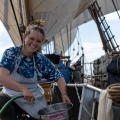

Navigating Rapa Nui is no easy feat. With imposing swell coming into the anchorage at Hanga Roa, we were forced to move to a more sheltered side of the island to allow for transfers of people and provisions between land and ship. We had spent the previous afternoon organising vegetables, sorting them into crates to be stowed for the voyage. This is a very important task, as it defines how long we will have fresh produce. Luckily, the galley team are experts of preservation, and we efficiently stored everything below deck for maximum longevity.

This morning, after some last-minute turnover work, the time came to wave farewell to the off-signing crew. This is always a bittersweet moment, a sore goodbye to part of our Europa family and the beginning of a well-deserved break for tired crewmates. To the sound of the ship’s horn, they were taxied to Rapa Nui. It was the most stable ground any of them had experienced since leaving Galapagos almost two weeks ago, despite the constant pressure of the Pacific Ocean threatening to engulf this tiny protrusion of land, a sore anomaly in a churning sea.


Bursting through the waves in plumes of salt spray, stretched hull and sharp keel slicing churning waters, a water taxi ferried fresh faces to the ship. It was a baptism by fire – or, rather, brine – for the new voyage crew, arriving early so that we could heave anchor and be on our way while they were inducted to Europa. This was an attempt to get ahead of the wind, to buy as much time as possible for the voyage ahead, as we would be facing the full wrath of El Niño, a disruption to the reliable system of ocean currents and winds, resulting in headwinds where we should have steady south westerlies. The Pacific will conspire against us in a climatic oscillation, the instigation of which science has no definitive explanation. All this was discussed in the evening meeting, where Captain Moritz outlined the strategy of tacking into the wind, adding miles to the voyage to save precious diesel, and Abi further detailed the El Niño Southern Oscillation (ENSO) cycles.


The route we will take is one that was likely well-travelled by the islands first nations, possibly as early as 1200 AD when Rapa Nui was first colonised. It follows a probable trade route of the Rapanui people, who voyaged 1120 nautical miles to the nearest inhabited island, Pitcairn. Here, the Rapanui could have gathered resources for ship building and food production, such as pandanus leaves for sailmaking, candlenuts for lighting, breadfruit for food and caulking, and mother of pearl for decorative pendants. In our embarkation for Pitcairn, we do not aim to find resources necessary for survival as the Rapanui did, but hope to learn about an island rich in history and character. This is a place defined by the infamous Mutiny of the Bounty, where a group led by Fletcher Christian overthrew Captain William Bligh and fled to the far-flung hideout of Pitcairn Island. What happened onboard the Bounty and how did the mutineers come to populate this remote island? What is it like to live as a descendant of one of these people, so physically isolated from an increasingly globalised world? We set out with a curiosity and hunger for adventure, maybe in some small way we can connect to those who have voyaged the central Pacific before us, and maybe we can return home with stories of our own.


