

Land Ho
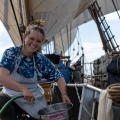

By now, we have sailed 1900 nautical miles from Galapagos and have crossed 26.5 degrees of latitude. While the unbroken horizon of blue remains the same, we can feel the southernly degrees in the cooler temperatures and gustier winds. After a few days of a high-pressure system, the air has stirred and we are experiencing the pleasant sailing weather of 20 knots of wind. Unfortunately for us, the directionality of this driving force is transient, and subsequently our morning was spent bracing and re-bracing, trying to optimise the angle of sail for speed in the direction of Rapa Nui.
Having read that, in 1774 when Cook made landfall on Rapa Nui, frigatebirds were sighted from 750 km and a great abundance of birds came into view at 750 km, we have had our eyes peeled for signs of life from the island but found nothing of the abundance of seabirds described by Cook. Over the past week, the occasional Rapa Nui native red-tailed tropicbird has investigated the ship on a journey out to sea. We have also sighted our old friends- the boobies – no longer blue- or red- footed but this time masked and brown.
They say that on a day of clear visibility, the island is visible to the naked eye within 90 km, but as we reached this mark and pressed closer to the land, dark clouds clung to the horizon. Occasionally the sun broke through the cotton-layer above, but for most of the time it too remained obscured.

Just as we were giving up on our search for clues of land, a call broke through the radio on channel 16. This garbled chatter confirmed that civilisation was nearby. After further wind changes and bracing and trimming, a shadow appeared on the radar. There was suddenly renewed interest in the lookout, and rumours of eternal good fortune for the first to sight land spread rapidly. Those on watch strained their eyes and scanned with binoculars for any clue of land in this bowl of ocean.
Meanwhile, the deck team set about landing preparations. Maintenance projects like the varnishing of poles, creation of baggy-wrinkles, and improvement of the manta trawl were stowed away, and in their place came the zodiacs, ready for tendering.
It was 17:00 by the time Rapa Nui emerged from the horizon. The island itself remained a dark cloud, slipping in and out of view in a manner much too transient for land that has persisted the ocean swell over the past 3 million years.


A squall once again reduced the island to bleak drizzle, and after striking the royals we took the rest of the sail away, ready to engine into the anchorage. Of course, there was furling to be done, and we scuttled up the rig for the final time. We divided between the masts, and each claimed a sail, bundling the white canvas and lashing it to the wooden yard. Periodically, we reminded each other to look up- we were encroaching on Rapa Nui and the shifty grey silhouette gradually developed into solid land with hummocks and green slopes and lava fields. We strained to see the legendary Moai, but for now all we could pick out was the few trees that peppered the ridges.
As the sun drew low to the horizon, we prepared to anchor. This meant that the voyage crew were no longer required to work on deck and were allowed a blissful night of sleep before the activity of arrival day. There was a giddy sense of anticipation amongst them, but also a melancholy that this chapter of adventure would soon draw to a close. After a celebration drink and some quiet chatter, everyone peeled off to their bunkies, well-deserving of a full night of rest.
