

Last day in Antarctica

Landings at Danco Island and Orne Harbour. Preparations for heading into the Drake Passage and starting our way to Ushuaia.
It is low tide as we arrive on the beach at Danco Island. The water is thick with amphipods—rice-sized crustaceans named for their many legs. Most amphipod species are benthic, spending their lives on the sea floor, but some—like these—are planktonic, drifting with the ocean currents, brought to the shore at low tide and receding into open waters at high tide. Scavenging any nutrients they can in the vast oceans, these alien individuals sustain the ocean giants.
Danco Island rests at the southern end of the Errera Channel, between the mainland peninsulas of Arctowski and Laussedat Heights. First charted by the Belgian Antarctic Expedition under Gerlache (1897–99) and named by the UKAPC after the Belgian geophysicist Émile Danco (1869–98), who died onboard the Belgica in Antarctica. The island is two kilometres long and about 160 meters high. It is home to a colony of gentoos, announcing themselves with coos, squawks, and a now familiar guano smell. They preen on the beach before making their way to the nesting sites above via the well-trodden penguin highways, now carved into the snow. With surprising efficiency, these small-legged animals shuffle and hop to their expectant chicks. We watch as the youngsters hassle adults for the products of their fishing trips, begging at their bills for regurgitate. Occasionally one individual roams into the nesting area of another; within reach of its bill, the invader is chastised with a sharp snap or peck, creating a domino effect as it is chased from one nesting location to another. The gentoos all nest exactly one neck-length away from one another—just enough space to be out of reach of their neighbours’ sharp bills. Five individuals reside on a rocky outcrop—a castle above the rest—carefully preening and distributing oil across their feathers from the gland above the tail. The work they put in now will keep them waterproof and buoyant on their next ocean voyages.
We reach Danco’s peak as light snowfall begins. The top of the island is domed in ice and offers views of the surrounding landscape—the Errera Channel, Ronge and Cuverville Islands, surrounded by rippled waters strewn with ice. We pause to drink in the scenery and take some pictures before returning past the colony to the beach.
Here we find the foundational remains of the British “Base O.” Active from February 1956 to 1959, the hut was used for topographic and geological surveys. It was removed by the British Antarctic Survey in 2004, not designated as a historic hut, and so dismantled for preservation of the wilderness environment under the Antarctic Treaty. Now, two concrete blocks with an information plaque remain.


We slowly make our way back along the beach to the landing site, stopping at points of interest. The photographers among us are fascinated by a large iceberg with a perfect hole through the centre, straining to catch a photo of Europaframed in ice. A singular red krill is washed up on the cold rocks, a reminder of the abundance of food these oceans hold. A Weddell seal lies at the top of the beach, unconcerned by our presence.
On return to the ship we hoist the zodiacs, passing Cuverville Island as we enjoy lunch. Humpbacks surround Europa as we round the first tip of the Arctowski Peninsula to our afternoon landing site of Orne Harbour. Spigot Peak looms over us at 258 meters, marking the southern entrance to Orne Harbour.
With our bellies filled and our foulies back on again, we are ready for our very last landing here in Antarctica. We enter the bay of Orne Harbour: an impressive rock cliff on one side and a large glacier front on the other, with our landing site sitting in between. We follow one by one up a steep snowy hill. Bright green patches of snow algae colour the otherwise white landscape, and in some areas the rain has washed away the snow, revealing glacier ice in light blue. We reach the top of the hill, where Jordi inspects the area for the best way to proceed. There are some smaller crevasses in the glacier ice, and we need to be cautious with our steps. Up here, with glacier ice, steep hills, and cliffs on each side, lives a small chinstrap penguin colony taking care of their chicks. How do they get up here, we wonder, as we ourselves struggle over the slippery rocks, snow, and ice. As we move further along this steep ridge, we get the answer. Down the hill on the other side, towards the Errera Channel, we see their highways. Penguins hike up and down between the nests up here and the ocean far down there. From the way they move, you would not believe these small fellows are up for a mountain climb, but here they are: some hopping from rock to rock, some sliding sideways downhill, and some hiking uphill as if it were no bother at all.

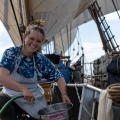
Down in the fjord waters below us we can see some distant whale blows, and around the fjord mountain peaks and glaciers fill the horizon. We spend some time up here enjoying the views and the penguins’ daily hustle and care for their chicks. Then it is time to head back to the ship. With a bit of an adrenaline rush, we cross over the tricky rocky and icy parts again, making our way to the snowy hill. The ship looks small down there in the bay, with the glaciers surrounding it. Back onboard, we do our usual cleaning of boots and deck and hoist Blacky up to the sloop deck. Grey still has another endeavour to carry out. A small team gathers with Johanne and Abi to do some ocean measurements in the fjord waters. Out in the zodiac, we tow a plankton net with a bottle below, collecting a sample of the amount and diversity of plankton in this fjord. We also lower a CTD, an instrument measuring temperature, conductivity (salinity), and depth. This will tell us about the hydrography of the fjord—how mixed or layered the waters are, and how much meltwater is influencing the water column. Back onboard Europa, we filter the net sample through a filter, and only half of the water is able to pass through, turning the filter brown with plankton. This shows us that these fjord waters are highly productive, which will feed the krill and eventually the whales, seals, seabirds, and penguins we have seen feeding in these waters. The temperature profile shows waters of around 1 °C with a thermocline—a rapid change in temperature—around 35 m depth. Together, all these measurements will tell us something about the state the fjord is in and which phytoplankton grow here.

Ninety-eight percent of the ocean’s biomass is too small to be seen by the naked eye. While phytoplankton blooms impact the ocean’s colour to the extent that they can be photographed from space, we often can’t observe them without the power of a microscope. It may be tempting to overlook such tiny organisms as unimportant due to the scale they inhabit, but they provide vast importance for life on Earth. Estimates of phytoplankton oxygen production vary from 50–80% of all atmospheric oxygen on Earth. They fix organic carbon and are the pastures of the ocean, forming the foundation of the marine food web.
Of these tiny drifters, diatoms are of great importance. They alone form about 40% of marine food and about 20% of Earth’s oxygen. These single-celled, plant-like beings have a silica body wall that forms strange geometric shapes—fragile skeletons that become over 30% of all ocean sediment.
As seawater in Antarctica warms and freshens due to increased meltwater from glaciers, conditions shift, favouring smaller and less nutrient-efficient flagellates over diatoms. Our samples will contribute to a much larger dataset used by the Scripps Institution of Oceanography (California) and the National University of La Plata (Argentina) to aid in understanding how these oceanographic changes will influence planktonic communities, in turn affecting processes of oxygen production, carbon fixation, and the ocean’s food webs.
With Captain Moritz explaining the plans ahead and preparing us once again for the Drake Passage, we motor our way out of Orne Harbour into the Gerlache Strait to the west. For the coming night the ship will be prepared for sailing, with safety ropes being installed as we move north between the Anvers and Brabant Islands.
