

Antarctic Peninsula
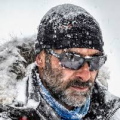

Taking the best of a short morning weather window: Zodiac cruise at Spert/Trinity Islands channels and icebergs. Ship cruise through Graham Passage. Whale watching under heavy snowfall. On our way south.
We awake onboard Europa, drifting in a glacial landscape: black rocks standing proud, built up by volcanic lavas and ash layers, carved sheer by tonnes of ice scraping seaward. Glaciers grind over scree, lubricated by a fine layer of water which is unable to freeze due to the sheer compression of ice above. Along the glacier front we can see lines in the ice, which indicate the layers formed slowly each season of snowfall. These layers are compacted with time, and the glacier is flowing down the hills, making its way to the ocean where the ice is calving off. Spert Island was first charted by Nordenskjöld’s Swedish Antarctic Expedition in 1901–04, later named after Sir Thomas Spert, Controller of the King’s Ships in the time of King Henry VIII, by the UK-APC in 1960.
The islands are too inhospitable to land for even a short period, so today is a small-boat cruise. Our zodiacs zigzag between growlers and through brash ice, voices are hushed and we hear the crackle and pop of air bubbles escaping melting ice. Swell crashes in the distance as the Bransfield Strait meets icebergs calved from the glacial feet; hollow booms echo through the channel as the bergs collide.
Some of the icebergs are massive, and it is hard to grasp the fact that what we see above the waterline is only 10% of the full size of the iceberg, the rest hidden below the surface. As the seawater and waves carve into the iceberg, the icebergs slowly melt from below, changing the point of gravity. At some point the iceberg will turn to re-establish its balance in the water. Some of the icebergs are so big that they are grounded on the sea bottom here, while others bob up and down in the swell waves. They all come in different shapes and forms, and some have beautiful blue colourations. These parts are denser ice where only the blue wavelengths can make it through and bounce back, while all the other colours are absorbed in the ice structure.


We pause for Weddell seals—first among the collection of scree and rock debris deposited at the foot of the glacier, then lounging on ice floes, each recovering from feeding trips to the deep. With each dive reaching up to 600 meters and lasting up to 45 minutes, the rest they now get is well earned. An imperial cormorant flies low over the brash ice. Unique in their family as the only species with plumage dense enough to remain watertight, these birds can dive up to 60 meters, sighting and pursuing prey whilst underwater. Terns flutter high and Wilson’s storm petrels swoop past our bow like bats as we pass through the strait between the feet of two glaciers, rounding the corner to the channel.

Icebergs shelter us from the swell of the Bransfield Strait as we squeeze into the shallow channel between sheer dark cliffs. Grounded bergs block the route forward, so we admire the rock faces to our port and starboard. Lichens are the first species to colonise the rock, secreting acids that erode the shattered face, allowing purchase for mosses. A meltwater waterfall tumbles off the cliff face from an unseen river below the glacier. Mosses cling to the rock surrounding this rare source of freshwater; resistant to desiccation, they make the most of the summer season’s freshwater spray before a long, dark, and dry dormant winter period. The next step in species colonisation of soil build-up from dead organic matter is limited to tiny cracks where small tufts of Antarctic hair grass stubbornly poke out. The extreme winds and vertical cliff faces provide an unforgiving environment, limiting plant life to only the most resilient.
Snowy sheathbills pick at the rocks below, scavenging for any nutrients Antarctica has to offer—be it in the form of penguin guano or seal poo. In such extreme environments, every resource is used twice before recycling into the ecosystem.
The winds pick up, so we turn back to the ship, accompanied by porpoising chinstraps as we cross the growing seas to Europa. Zodiacs hoisted, we leave Spert Island behind, pressing forward to the Gerlache Strait.
Not before taking a short detour to pass by the scenic Graham Passage. Today, under snowy weather, though the winds have died out as we sail south, this narrow and winding channel separates Bluff Island from the west coast of Graham Land (Antarctic Peninsula). Named by Captain Skidsmo after his whale catcher Graham, which was the first to pass through it on 20 March 1922.

And sure enough, by that time there were quite a lot of whales around, and after depleting their populations due to intensive commercial whaling, nowadays their numbers are recovering. For us, even though the snowfall is intense, the sight of them just at the southern mouth of the passage is pretty impressive. Several groups of three to four humpbacks dive, swim, and feed in the area. The ship stops and drifts, then a handful of them pass close by her hull.
For the rest of the evening and night, we make our way southwards, planning to be in the morning at the entrance of the acclaimed Lemaire Channel. Dusk falls, then a couple of hours of darkness; the snowfall lightens up, Europa’s decks and rig are under a white blanket.
By Johanne, Abi & Jordi
