

Lemaire Channel

Landing at Yalour Islands and steering back north to the Gerlache Strait area.
Low clouds, sleet, rain, and 35 kn of headwinds overnight. It didn’t look so promising for a morning scenic cruise along the renowned Lemaire Channel. Already by 6 in the morning the ship is positioned close to the northern entrance of such a beautiful waterway, drifting and waiting to start the passage at about 8 AM. As the ship lingers around the area, the weather slowly but gradually improves: the clouds start to lift a bit and the wind stops blowing. Yet another of those weather changes to which we are getting so used already by now, after just a few days in Antarctica.
The imposing peaks of Cape Renard, that frame the beginning of the Lemaire Channel on its eastern coast, are still hidden under a grey cloud cover, but their lower slopes and glaciers soon come into sight. As do the rest of the high, steep peaks of the Antarctic mainland and Booth Island, at either side of the ship.


It has been a long way to get quickly here all the way from Spert Island, but worth the try, as the channel is considered one of the most beautiful landscapes of the northern area of the western Antarctic Peninsula, and today it was about to offer an excellent cruise as we made our way southward through it.
This striking channel was first found already in 1873 by Dallmann, during his German expedition aboard the Grönland(1871–74). Those times represented a sort of gap years during which not many ships ventured into those Antarctic waters. Besides Dallmann, the 1844–1845 British Admiralty Expedition and the British Challenger Expedition, there were just a few sealers around. Now and then they started to exploit again the seal colonies that began to recover after the first heavy hunting period right after the South Shetlands and Antarctica were discovered a few decades before.
The channel had been sighted, but it was 24 years later when it was first sailed. It was Adrien de Gerlache aboard the Belgica, and he gave it its name after a Belgian explorer who had actually never been in Antarctica but in Congo (Africa): Charles Lemaire.
The confined waters along the narrow channel offered good shelter from waves and winds, making it a great opportunity to climb aloft, both for more familiarisation with stepping on the yard footropes or going higher on the shrouds and ladders, and to bring cameras up there to take pictures of the impressive surroundings.
Glaciers tumble down the steep slopes; now a crack, now a small calving here, then a little avalanche there. The waters in the channel, often filled with icebergs, bergy bits, growlers, and even sheets of sea ice, today are relatively free of them, and just a few icebergs have made their way here.
After a good couple of hours we leave the narrows of the channel behind and enter the more open area of the Penola Strait. Here larger icebergs drift or are stranded over several patches of shallower waters as our destination for the afternoon gets into view. It is just before lunch when the wind starts to pick up again as we get closer to the northern shores of Yalour Islands, the little archipelago located in the shadow of the headland Cape Tuxen.
This impressive cliff stands out between the high mountains of the Antarctic Peninsula and the many icebergs around as we approach the area with the ship. A prominent rocky outcrop as a backdrop to a beautiful Adélie penguin colony, it stands as a witness to the historical expeditions led by Gerlache (1897–99) first, then Charcot (1903–04 and 1908–10), who first visited the area.
It proudly stands at the southwest entrance of Waddington Bay, in the Grandidier Channel, and was first roughly charted by the Belgian Antarctic Expedition under Gerlache on 12 February 1898, and named Cape Tuxen, probably after a supporter of the expedition. But it was right here where Charcot, during his first expedition (1903–04), took the honour of setting foot on the mainland west coast of the Antarctic Peninsula for the first time confirmed.

He returned to this very same spot during his second expedition (1908–10). Just at the base of the cape they set up an exploration of the area in a small boat, with the bad luck of becoming stranded for several days before being rescued. Their misadventures didn’t end with this, as their ship, the Pourquoi-Pas?, ran aground here. But Charcot continued his explorations further south without letting the crew know the real extent of the damage. A dangerous enterprise that nevertheless worked out well, as afterwards they overwintered at the neighbouring Petermann Island and then still could return safely to South America.
You secretly find out that your keel had been badly damaged by hitting a rock. Do you accept defeat and turn for home, or do you conceal the truth from friends and colleagues and sail back into the ice and uncharted waters that holed her?
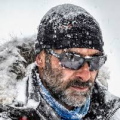
Jean-Baptiste Charcot
This afternoon landing, under the ever-present look of this famed cape in the background, was to be at the small archipelago of Yalour Islands. A series of rounded hills rising above sea level and sticking out of the snow cover on their lower, gentler slopes, each topped by a small Adélie penguin rookery.
We sailed straight south all the way here, over 65° S, to have the chance to enjoy the first penguin colony of our voyage and the truly Antarctic landscape, so different from what we had until now. Furthermore, these are the latitudes on the west coast of the Peninsula where the distribution of the Adélies starts: a biological, climatic, and oceanographic limit where they can enjoy cold, icy waters and large amounts of ice. To the north is the territory of the chinstraps and gentoos. But here, Adélie penguins live and breed in a favoured location and picturesque surroundings. Despite the cloud cover and the passing rainfall, the views we had ashore were delightful. The whole area is framed by the high peaks and impressive glaciers of the mainland; to the south, more open waters, but peppered with icebergs.
The penguins come up and down to the sea using their highways back and forth from their colonies to feed their chicks. Amongst them there is a disparity of ages, some small and still downy, others almost fledged. For a good couple of hours we walk over the island, having a good time amongst the penguins. In the meantime, the weather starts to deteriorate and the wind begins blowing stronger. Time to return aboard and start our way back again through the Lemaire Channel towards tomorrow’s new adventures. Weather of the worst kind is predicted to hit this southern area starting tonight and lasting all day tomorrow; better to avoid it by sailing about 60 nm northwards and try our luck there.
