

Sailing in the Chilean channels Fiordo Peel - Estero Amalia (Skua Glacier)

Year 1579, month November. Captains Juan de Villalobos and don Pedro Sarmiento de Gamboa set sail from Callao in Peru aboard the San Francisco and Nuestra Señora de la Esperanza respectively. Their mission: explore, map and chart the Patagonian Channels and Straits of Magellan. Reconnaissance of the whole area to find out if any English settlers were around, and chase the privateer Sir Francis Drake, the nightmare of the Spanish fleet in South American waters. They had the task as well to study options to build Spanish defensive forts wherever possible in this harsh landscape and environment, claiming the territory for Spain.
Two months later, under a fierce storm, the two ships drift apart. San Francisco makes it along offshore waters to the 56° parallel and only then is able to turn around and finally make port in Valdivia. But other fate awaited the Nuestra Señora de la Esperanza. She was able to follow her assignment to explore the channels and make way into what they called the Strait of the Mother of God, nowadays well known as the Straits of Magellan.
We have to wait for a Sarmiento de Gamboa second expedition for the first attempt at bringing a small group of settlers there, and completing the commission of the defensive posts building. He actually did it in 1584, founding Nombre de Jesus and King don Felipe Forts in the Magellanic territory. Left alone to live and with the idea to thrive there, the story ended up quite the contrary. It was in 1587 when the English pirate Thomas Cavendish sailed by, finding the settlements and inhabitants in such a state of abandonment, desolation and death that he renamed Fort King don Felipe as Port Famine or Puerto del Hambre.
Nowadays the main channel we navigated last evening and along the night bears his name, the Canal Sarmiento. This major waterway in the area, easy to navigate in good weather, often funnels winds from the north gusting along the straight channel which offers no shelter options, making the progress northwards slow.


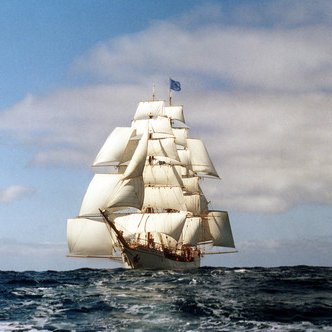
Further north, we take a turn to starboard and get into the calmer waters of Estero Peel. A wide inlet 45nm long with four secondary arms that cut deeply into the high Patagonian mountains. Europa heads toward Skua Glacier. The glaciers here are fed by the South Patagonian Icefield, the largest of the South American icefields. It stretches more than 350 km and has more than 50 outlet glaciers draining it. We notice the water here is milky green; this is due to all the silt and fine sediments brought into the fjord by the large quantities of glacier meltwater runoff. As we admire the green colour of the water and the landscape, the sun peeks out through the clouds and the weather is now dry. The deckhands are quick to bring out a sail that needs mending, and soon the sun is sparkling on the green fjord water. Some Peale’s dolphins appear, closing in on the ship and joining the ride. They speed along the ship, playing by the bow and doing acrobatic turns and sometimes jumping out of the water. They follow us all the way into the fjord where Skua Glacier debouches, where bits of drifting ice start appearing before the glacier slowly comes out behind the hills. An impressive blue and white crevassed flow of ice from two valleys meets the fjord. A small yacht is slowly moving from the glacier front towards us, looking tiny in front of this massive wall of ice.


We land on some rocks near the sandy beach in front of the glacier. The granites where we step show wide bands of basaltic intrusions. The smooth surface also shows signs of the heavy glacier ice moving over it, scouring the surface. As we get ashore and move up the rocks, we notice lichen and small mosses growing on the smooth surface of the rocks. Further in, grass, bushes and then trees cover the landscape. This is the succession process in place, establishing new forests as the glacier is revealing new land as it retreats up the valley. The mosses and lichen paint the landscape in a variety of colours: pink, green, orange, red. The landscape of vegetation in front of the blue of the glacier front is impressive. Closer to the glacier, the dark sand and sediments also reveal colourful rocks of green, orange, red, pink and bluish green, and deep ponds of glacier water give hints of blue. What a spectacle of colours in one place! We walk along the glacier front enjoying the scenery and move up on the vegetated rocks and hills to get some different perspectives. It is incredible how much variety in the vegetation growing on top of these hills with the sandy deserted plains below on either side. Some streams flow out from the glacier onto the sandy plains, revealing more of the milky-coloured silty glacier water. Every now and then we can hear some roars in the distance; bits of the glacier are calving off further down the glacier front. And the rain, the rain is pouring down most of our landing, giving us a break for a few minutes here and there. Although we wished it would be drier, it is part of this landscape, making it possible for the lush vegetation to grow and thrive. Further up in the mountain tops and the larger icefields, this rain is falling as snow, accumulating layer by layer, year after year, eventually creating new glacier ice which flows down the valleys towards the fjords, becoming part of the glacier front and contributing to this astonishing landscape.
An outstanding corner of these fjords, an energizing landfall in a powerful scenery.
Then it is time to head to a nearby sheltered bay to drop anchor and spend a quiet night, where we don’t have to steam our way north as the next spot we want to explore lies not far away.
It is after dinner when the chain rattles down and the anchor touches the sea bottom at Caleta Valdivia. During the night, for a moment the full moon shines, the rainy weather gives us a short break.
