

Wilhemina Bay, Orne Harbour and Orne Islands
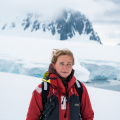

We knew it would be the end of our sizzling sunny days but the beauty of the snow falling on the water’s surface which was alive with feeding humpback whales was a surprise to wake to. Those who were up for sunrise saw the full show of whales all around the ship. As they moved between feeding frenzies they occasionally came to check us out. The screeching sound they make as they surface was comparable to an elephant using its trunk or a wet boot on the zodiac rubber to suggest one more familiar in this environment. To prevent disturbing the humpbacks as far as possible it was decided to turn the engines off and the generators. The galley team were very cooperative even chopping up onions under headtorches.
The morning went on like this. It almost became a non-event when there was ‘just’ a blow from a humpback seen more that 500 metres away. The pectoral fin slapping was a display that went on long enough for even the galley team to get a good video of. Later we enjoyed imagining that the in-time diving was a synchronised swimming routine that they had been preparing for us with coordinated flukes and pectoral fin slapping responding to breaching, all in one frame. It was said by a few that they could never go on a whale watching tour again after this morning.


During the black ship, Olivia also got out her hydrophone which enabled to listen to the whales underwater. We could hear some communication but most of all, we thoroughly enjoyed Olivia’s facial expressions of excitement as the whales made themselves heard.
Of course, this had led us astray from our schedule this morning so the fjord phyto citizen science project was getting repeatedly pushed back. After coffee time we finally started the explanation but even Abi’s enthusiasm for phytoplankton was interrupted by the charismatic megafauna that stole the stage again while her explanation was in full swing. When we eventually made it out in the zodiac, the snow had transitioned into rain and the visibility had reduced. With our 5 scientists from the voyage crew, we began our net towing and lowering of the CTD scanner. The small bottle was filled with a water sample before we oriented ourselves towards the ship and headed back to filter our sample.


Back on board, Ben was giving away his photography tips which was well attended. Possibly something to do with the announcement of the photo competition last night! There is already a large array of photos and videos being shared among the group as we learn from each other’s styles and creativity.
Over lunch Dan repositioned us round Cape Anna to Orne Harbour. This was our first landing on the Antarctic Peninsula mainland, as opposed to the islands which we had landed on so far. Even with a few interruptions by whales, we made it in good time. With some brash occupying the landing site, we pushed our way to the rocks where we began our up hill zig zag to the coll. We took regular breathers on the way up to look back at what looked like a tiny, toy Europa in the bay of noisy tumbling glaciers. To continue on our track record of luck so far, the clouds continued to rise revealing the craggy faces of the surrounding high mountains.

At the high point we were rewarded with spectacular views south looking out across the Errera Channel. The sun was even managing too pierce through the clouds in places, lighting up individual ice bergs and mountain sides. Those with binoculars could pick out whale blows scattered across the area.
As we were on our back to Europa, we had a call from Captain Eric that he had spotted Orca in the bay. We all stumbled across the slippery rocks to get our lifejackets on as fast and we could and board the zodiacs back to the ship. On route back there we large flotillas of gentoo penguins and repeated blows and dorsal fins of humpbacks but the tall triangles of the Orca’s dorsal fin were heading out of the bay into the choppy Gerlache Strait.
Back on board we were familiar with the zodiac operations now and all worked together to get them onto the sides of the hull for our short transit to Orne Islands. The wind had increased slightly and the clouds had cleared revealing the dramatic scenes of glaciated mountains on Anvers Island to the west.

After an early dinner we arrived at Orne Islands which was nestled in between some large ice bergs. The scalloped dimples and air bubble carved runs on the sides of the ice made them endlessly beautiful to observe and photograph.
Once ashore we could only make it a very short distance to the crest of the slopes before we had to pause and reassess the density of wildlife. To our left there were two fur seals having a play around. Ahead there were a couple of skuas on a rocky outcrop keeping an eye on the still young and fluffy gentoo chicks. Fur seals were also spotted in the water trying to haul out of the slippery ice bergs. They were mainly unsuccessful which was entertaining to watch and a good challenge to capture on camera.
After some gentoos had crossed, there was room for us to make a few more steps to the next rocky outcrop surrounded by a snow patch. From here we got some more height which was well worth it as we could see two fluffy light grey skua chicks. With the binoculars we could see their big goggley eyes and the oversized feet which they lolloped about the outcrop on.
It was nice to have some of the crew ashore with us this time too, enjoying a short landing after they’d finished their watches. Once we had our fill of gentoo chicks, playful fur seals, whale blows, sunlight spot-lit ice bergs and dark skies rolling in, we made our way between the big ice bergs back to the ship. It was a team effort to get the zodiacs back on board again so we could head over to our anchorage at Cuverville Island.

Protected in behind the island, we anchored for the night. The shallow water that was upwind and up current of us, captured all the larger ice bergs, making sure there wasn’t too many to doge during the night. With the tide flowing past the boat, Eric was able to manoeuvre the ship to let the spaller pieces of ice pass with just the rudder and no propulsion from the engine.
