

The art of furling

Furling is an art more easily learned from practice than described in text. Equally, it is also an experience rather lived than told of, but for the purposes of this entry the latter shall suffice.
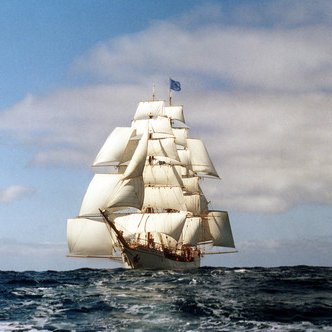
Furling a sail at sea is as much a part of operating a ship as bracing, setting and striking a sail, and it often becomes necessary depending on changes in the wind’s direction and strength. It necessitates that crew first strike the sail, subsequently lay aloft onto the yard of the designated sail (often the light-weather sails such as the Royals and Topgallants) after it is “in its gear,” and then pull the sail snugly up to the yard by hand, where it is tightly wrapped in a gasket and secured to the jackstay to prevent it from flapping around in the wind, which may lead to chafing.
During an increase in wind speed, Peter and I went aloft to furl the fore royal, the highest and smallest of our sails, making our way up the shrouds of the foremast, watching the deck grow ever smaller beneath us, and the ocean expand further and further beyond the horizon. Stepping onto the footrope of the yard, you could feel the temperament of the wind gushing past, and as the ship heeled to starboard with the wind, I could do naught but hold on and focus on the work ahead; moving out to the furthest part of the yard, bellowing wind above and churning waves below to begin the task, undoing gasket by gasket, wrapping each around the yard, hoisting up chunk after chunk of sail, tying it off as we worked our way from the outside of the yard to its centre. You move as the ship does, heeling along with it and the wind. As you lean, flat on your belly, over the yard to grab hold of the sail, you are confronted with 30 metres of uninterrupted nothingness, until the sea rushes up to meet your gaze before melting away into an endless field of blue. It is a feeling rather experienced than told of, and no words I could put down will do it justice. You are not afraid, but the animal of your body understands just how wild a situation you are in, with or without safety lines and carabiners, and I will commend any and all that make it look as easy as the crew here makes it look, for it is no trifle.
Suffice to say, it is an experience that instilled in me a profound appreciation for solid ground, an even profounder appreciation for all that do it, and a great desire to go do it all over again.
