

The open ocean
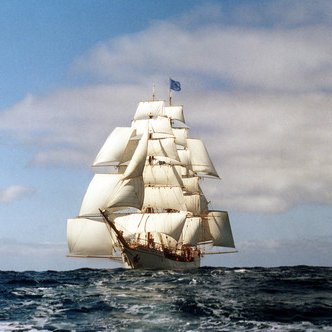

The open ocean is a spacious place, both in the sea and in the air.
There are not many birds around, but the list of species we may see is longer than we would expect. Some of us started the eBird bird survey, noting down the coordinates of our location and whether we observe any birds and, if we do see some, trying our best to identify which ones we see. They all look very similar at a distance, and when the juveniles can look identical to a different species, this is not an easy endeavour.
The sun was out more often now as we were heading slowly into an area of high-pressure systems. And we could see it in the measurements. The barometer showed 1014 hPa before we approached Vava’u, now it had risen to 1019 hPa. Going through some meteorological tables in the wheelhouse, we found that the humidity was around 72% before Vava’u and now down to 63%. Lower humidity means denser air, a counterintuitive fact as humid air feels denser to breathe and our skin feels stickier. The scientific explanation is that as the water vapour molecules take up space in a parcel of air, the heavier oxygen and nitrogen molecules are displaced, resulting in more of the lighter water molecules. It is exciting to see how the theory shows up in the measurements.
Higher pressure often means drier air and fewer clouds. And we could feel how the return of the sun gave us more energy and enthusiasm. Johanne gave a lecture on surface ocean currents and how the wind is driving the large-scale circulating gyres of the ocean. The South Pacific Gyre is helping us on our way to New Zealand, leading the way down south, making our speed faster than when only led by the wind itself.
A spectacular sunset was on display as the day came to a close. Music was flowing with the wind as we enjoyed the setting sun and orange sunbeams stretching out between the low clouds.


