

The sea was calmer today and the sun rose into clear skies
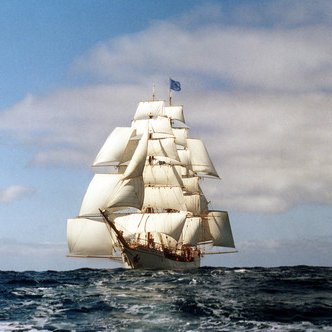

A band of cumulus clouds was hanging low above the horizon.
These conditions meant painting and scraping work was on the agenda and many of us were eager to help. The ventilation pipes were painted yellow. The cabin top of the wheelhouse was scraped and sanded. Lizze brought out potatoes to be peeled.
In the afternoon, the plankton net was brought out, a net with small-sized mesh, a circular opening and a cod end to collect the plankton. We lowered the net from the poop deck and trawled for half an hour. Down in the Southern Ocean waters a trawl of just 5 minutes will give a good sample, but here in the tropical Pacific, the waters are a lot less productive and so we need to trawl for longer to get a good sample. Here the plankton are also smaller in size, adapting to a life with scarcely available food. And what an exciting result. Under the microscope we could identify several different types of zooplankton: tubularian worm, polychaete larvae, foraminifera, snails and copepods. A favourite was the deep blue-coloured copepod. This tiny creature lives in the top millimetre of the sea surface, a harsh environment of high fluctuations in temperature and strong UV radiation. The blue colour is found to be of the same wavelength as the light the surrounding sea water is reflecting, making it perfectly hidden from predators.
With many of us excited and patiently investigating the little creatures under the microscope, others of us joined Clara for another type of trawling from the poop deck. Back in the days before modern navigational instruments, the speed of a ship was measured with a rope of equally spaced knots thrown overboard and counted. This is where the speed in knots comes from.
For the 8 o’clock a special surprise was waiting for us. Sue’s birthday was celebrated with carrot cake and the Danish birthday song led by Jonna. And if that was not enough of a celebration, a deep orange-coloured, nearly full moon was on the rise outside. Slowly she rose higher in the sky, lighting up the clouds, the wave tops, and the sail canvas, greeting us and leading us into the night.


