

The first day on the Drake
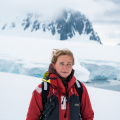

The morning began with thirty knots of wind, two-to-three-meter swell and yellow buckets under heavy use.
We are reminded of what it means to sail these waters- a lone vessel in a vast ocean- Europa is a guest in an unforgiving environment while simultaneously being deeply at home on the open blue. It is a surreal experience, in the twenty-first century, to explore waters like these on a vessel like this.
We conducted the first bird survey of the trip in the hungry half-hour before lunch. Gathering on the poop deck, we set in place a protocol that was to become a twice-daily ritual of staring out to sea in search for winged residents of the Southern Ocean. Bird sightings were announced with a call and outstretched hand, while we clamoured to glimpse what someone else had seen. The survey was a fruitful indication of the area we inhabited- black browed and grey headed albatrosses, southern giant petrels, a great shearwater on the southern edge of its range and a sooty shearwater darting low between waves. These are the species typical north of the convergence, an oceanographic feature causing and ecological barrier that we will discuss later as we reach it.
This was followed by the greatly anticipated lunchtime. A buffet of bread and cheese and salad and soup provided the nourishment we all needed after the morning’s activities.

The afternoon started with a talk from Beth in the deckhouse on the charismatic birds which draw us to this region: the penguins! Due to the generally fragile condition most of us, it was nice to come and go, looking at the horizon where needed and chipping in with questions and anecdotes as we went. These superbly entertaining individuals may look clumsy and incompetent, but their adaptations and elegance in these icy cold regions is impressive.
The time had come to jibe – the process of turning the stern through the wind to the opposite tack, during which we were lucky enough to glimpse the first great albatross of the trip.
As a young Herman Melville so poetically wrote on first seeing these mythical seabirds in 1841, ‘Through its inexpressible, strange eyes, methought I peeped to secrets which took hold of God. As Abraham before the angels, I bowed myself; the white thing was so white, its wings so wide, and in those for ever exiled waters, I had lost the miserable warping memories of traditions and of towns. Long I gazed at that prodigy of plumage.’ But the time to reflect on this emotive glimpse had not yet come, as the staysails needed to be dropped, yards braced, and spanker sheeted out, a process requiring many hands and not-so-light work.


The day was wrapped up with a second bird survey (during which we saw black browed albatross, a southern giant petrel, black bellied storm petrel and a wandering/royal albatross), a dinner, and an eight o’clockie in which we introduced the Southern Ocean as a continent surrounded by water, touching on the polar convergence as temperate and polar water masses meet. Then, it was time for the night watches.
