

T-30 for wake-ups
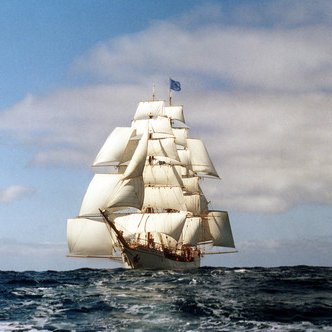

On day one, after embarkation in Piriápolis, Uruguay, I asked one of the sailors who had just completed the six-week ocean crossing from Tenerife if she had any advice for inexperienced sailors like myself. She replied, smiling: ‘There are only two rules you should follow. The first is to sleep when you can sleep, and the second is to eat when you can eat.’ It only took me two days to realise how right she was.
There are probably sailors on board who are much more poetic than me, and who can make you feel like you are right here with us, watching the beauty of the endless waves on the ocean, spotting whales, dolphins and seals on starboard side – oh no, now they’re on port – wait, there are even more on starboard. I cannot find the proper words to describe the sensation of standing at the helm at 1 am in the morning during a dog’s watch under sail, like I did this morning, feeling every gust of wind and every tug of the rudder, trying to remember the patient but very clear instructions of the first mate after we accidentally moved too far into the wind, with a clear sky full of stars and the milky way clearly visible above your head (which you obviously cannot properly look at because you are trying to steer a 56-meter bark on the right course).
Rationally, I have always understood that time is a social construct, but being on board Europa has really given me a deeper understanding. One thing that helps is that our standard greeting is “good morning”, no matter the time of day. Because of the watch system, people go to sleep and wake up at all hours of the day and night, so it’s easier and friendlier (especially to the latter group) to greet everyone the same. The delicious smells from the galley don’t help either in determining your position on the clock, because you can smell fresh bread or soups being prepared all day. The permanent crew is just as helpful, passionate and patient at the start of their shift as at the end, which makes the learning experience so much better. This morning, I tried to remember whether I put on this particular pair of socks 8 hours, 16 hours or 3 days ago, and I still have genuinely no idea. And the best part is that it doesn’t really matter, either: I smelled them and they can easily last a few more hours.
Time just feels very different on a journey like this, and the agreed upon 24 hours that make up one day behave very differently depending on what you are doing at the moment. You can spend an hour looking at waves or whales, and feel like half a day has passed (also good to know is that we have decided to name every whale Bob, because there was so many of them the last few days, and we couldn’t keep track anymore). Or you can spend 30 minutes on lookout in the middle of the night, rocking and rolling on the foredeck and getting splashed, and be surprised when your watch mates come to relieve you after what feels like only 30 seconds. A friendly game of Saboteur can take hours when your fellow kabouters are running off to raise two, three or six sails mid-game, and doing tai chi (or tai ship, as we call it) on a rolling ship makes total sense at 5:00 am after you watched the sun rise together. The place where time really seems to come to a complete stop is the dungeon, the sacred domain of the engineers on board. And nobody blinks an eye when sailing instructions come to a complete halt when more big Bobs are spotted, even if it happens three times in the course ofone workshop (sorry, Vera!).
At home, I feel like I spend my time either trying not to be late to something, or already being late for something. But here, the clock is just a neutral tool. It tells me how many minutes before I can wake up my watch mates who are on the next watch (T-30). Or whether I should eat two cookies right now, or just wait a few minutes because it’s almost lunch time. Obviously, it does not matter how you spend your time, but it’s the people that you spend it with that make it so great, and I’m really grateful for all the meaningful conversations, the dance parties on deck, and the fun and jokes. And even though the clock is a helpful tool, it’s not even the most important one. There’s another round instrument covered in numbers that’s way more important: it doesn’t show us when we want to go somewhere, but it shows us where we want to go. Right now, the most important number is 170, because that’s the course we’re sailing South to reach Ushuaia, Argentina, on 26 December.
