

Manta Trawling
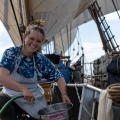

Today, a lull in the trade winds allowed us to deploy the manta trawl. This is what we call the instrument used for collecting plastics from the surface of the ocean, named after the elasmobranch for its gaping mouth and large wings. Its deployment is an elaborate procedure which has, over the years, been finessed into a slick system. We took a break during the trawling to review the samples.

We were pleasantly surprised by how low in plastic the samples were. Of course, any plastic in such a ‘drop-in-the-ocean’ sample is disappointing, and a few polymer particles stood out amongst the debris collected- a piece of polystyrene, a red fibre, a transparent film.
The aim of manta trawling is to collect a sample of microplastics from the surface of the water, but we often have a planktonic by-catch. We separate them from the plastics to study the species associated with the litter: how do microplastics affect the planktonic life? Are some species impacted disproportionately to others? The trawl today was primarily a learning experience, so we had a close look at the abundance of life before carefully preserving the samples for laboratory investigation.
In the cod ends (the part of net collecting the samples), we found many fine examples of blue buttons Porpita pacifica. Discs of cyan, diameter 2.5 cm across, underside carpeted with short but potent stinging tentacles. These hydrozoans float at the surface of the ocean, stunning and entangling zooplankton in their hungry tentacles. Their predominant food source, juvenile fish, were also present in the sample, shimmering flecks of silver, some with fins developed for gliding through the air, others with needle-noses for feeding. Of course, the blue buttons have predators too. We caught a fine example of a violet snail, vivid purple spiralling into whorls of lilac, suspended upside-down by a mucus bubble-raft, drifting the oceans in search of prey but now unceremoniously dumped into a sieve for inspection. And then there are the Portuguese man ‘o’ wars. Tens of air sacs like bubble-wrap littered the sample, tentacles separated from their bodies and washed into the finely meshed sieve by our indiscriminating fresh-water hose. We were careful in manoeuvring these specimens – well-aware of the reputation they carry.


Evidence of airborne life was present in the form of a large primary flight feather. It was clear that it had been traversing the surface ocean for some time as juvenile goose barnacles sprouted from its base, and sea mat (bryozoan) coated the barbs.
Despite having seen no birds during the 30-minuite birds surveys over the past few days, we were interrupted in our exploration of the samples by a pair of tropicbirds. They fluttered past the ship much higher than most ocean-going birds, in line with our royal yards, curiously circling the ship before disappearing into the horizon. As we watched them, two storm birds glided low over the waves; a Juan-Fernandez petrel followed by a white-necked petrel. We were filled with the buzz of having seen fellow voyagers out there in this lonely blue – somehow feeling more kinship to them than the plankton we had just been investigating.
The diversity and abundance of life in the surface ocean is consistently astounding, and an important reminder that all life on earth evolved from small planktonic drifters in the ocean like these. Entire ecosystems exist in every drop of seawater we sail through, worlds different to, and part of, our own.