

Sailing to the Galápagos

We have truly found the Southeast trade winds now. Concerns of El Niño’s effect on our driving force have faded, and we roll downwind with eighteen knots behind us.


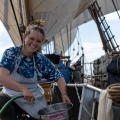
For now, we are not pressed by sail handling or manoeuvres, and concerns of the deck team lie in the endless maintenance of life at sea. Nat is repairing a ripped stunsail with a very temperamental Elna (baby sewing machine), while the deckies inspect rigging and safety equipment. Voyage crew ping-pong between helm, lookout, sail training and daily lectures. Together, we have discussed everything from points of sail to evolution, knots to plankton, staysails to ocean currents. But this has been a voyage defined by history. Deeply aware of the footsteps in which we follow, our minds turn to the humans who first set sail from South America, landing at the archipelago of Galapagos.

In 1535 Fray Tomás de Berlanga, the Bishop of Panama, swept off course while travelling south, now in a life-threatening position, landing on islands where fresh water is scare. Surviving only by capturing and eating tortoises, the crew couldn’t return home fast enough. The Flemish cartographer, Orteliu, lazily charted the islands in 1536. After naming the Galapagos for their tortoises - choosing a word rooted in the Spanish word for saddle, referencing the reptiles’ shells - he reported nothing of value but the fresh meat of the large creatures. The islands became known as Las Encantadas (The Enchanted Isles), not for the wonder of their nature, but for the bad luck required by anyone to end up there.

Pirates, buccaneers, and whalers followed before the first long term human resident of the island, Irish Pat, marooned on Floreana in 1807 and remained for 2 years. The islands were used as penal colonies and wartime bases, but all establishments proved fickle and the islands were, at most, sparsely populated.
Galapagos has been a source of inspiration to many, with accounts of visiting buccaneers and whalers inspiring Daniel Defoe’s Robinson Crusoe and Herman Melville’s Moby Dick. Of course, the archipelago has been enshrined in the legend of Charles Darwin, a young naturalist rebelling against his father’s wishes that he study medicine, instead a naturalist aboard the Beagle, and on the precipice of a discovery that would change how we see the world forever. Having only spent five weeks on the islands, and with most of his time occupied by hiking and collecting and meticulously sorting, it would take Darwin another twenty-four years to publish his defining work, On the Origin of Species.
We eagerly anticipate what the islands have in store for us- for many the trip is a life-long dream, an attempt to in some way feel the inspiration of far-flug lands, distant voyages, and uncanny creatures that struck Defoe, Melville and Darwin. For now, though, we savour the rhythm of the open ocean, making the most of stretched horizons and air seasoned by the sea as we earn our place as seafarers aboard Europa.


