

Sailing from the Galápagos to Easter Island
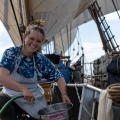

After three days at sea, we have settled into a new routine. For the voyage crew, this consist of four hours of helm, lookout and sail handling, followed by eight hours of rest. There is now time to learn about the oceans, the abundance of life they contain, and how to navigate them on the technology of a tall ship. Days are interspersed with sail training, scientific lectures and meal-times. Today, we recapped square sails and points of sail, and played the ‘evolution game’ in which we organised different classes of animals in the tree of life.
While in Galapagos, we experienced first-hand the speciation between organisms on the islands that so infamously inspired Darwin’s, ‘On the Origin of Species’. We learned how giant tortoise species are grouped by shell shape (saddle-backed, domed and intermediate) and how every volcano has its own distinct species. Each island has a mockingbird, appearing similar but those of Floreana with more blotching on the side of the breast and San Cristobal’s with a more defined eye mask in adulthood. Of course, there are the finches, beak shapes adapted to the niche they fulfil, be it a life centred around cactus or tree or ground.
A curious 26-year-old, visiting the archipelago as a naturalist under the captain Fitz-Roy, Darwin didn’t come to any conclusions on evolution until much later in life, and, even then, not without great inspiration from his predecessors and contemporaries.
When boarding the Beagle in 1831, Darwin’s condition to sail was that his cabin have space for his collection of Humboldt’s, ‘Personal Narrative’. From penguins to national parks, squid to ocean currents, Humboldt gave his name to many a species or feature. His impact on the scientific world was predominantly to move away from a deconstructive, ever more specific view of the world to a wholistic, pattern- and process-based way of thinking. Devoting his life to the exploration of natural sciences, Humboldt greatly prioritised mentorship and financial support for the next generation of scientists, Charles Darwin included.


Another of Darwin’s major influences was Charles Lyell, who in 1830 published a controversial but widely-discussed text on plate tectonics, ‘Principles of Geology’. This opened the door for consideration of a natural world in continual flux, challenging the definite creation of earth by an omnipotent God. What if the world wasn’t perfect and fixed but in a continual state of refinement? At the time, this divisive theory had both ardent proponents and stringent deniers, referring to it as the Transmutation of Species.
Of course, there was Alfred Russel Wallis. After exploring Southeast Asia, he proposed the Wallis-line, a delineation through Indonesia where species diverge. Few species of plants, birds, or terrestrial animals cross this line. Most marsupials live on the Australian side while placental mammals tend to occupy the respective biological niches north of the delineation. Publishing these observations in 1858, Wallis came breathtakingly close to the theory of evolution, and spurred Darwin to push forward his own publications from a full text of, ‘the Big Species Book’ to an abstracted, ‘On the Origin of Species’.
On a voyage like this, we are abundantly aware of the fact that each person’s contribution is a small but essential part of the expedition. We take turns at the helm, and steering the ship feels like an important job. Others, like our engineer, tinker behind the scenes, making sure the freezer runs cold and toilets flush. Deckhands repair sails and carry out rig inspections, the bar hand ensures we have clean clothes and fuels us with coffee and beer. We might not notice their hard work until things start to go wrong and we are suddenly left with nowhere to store our three-week supply of meat, a rig in disrepair and no coffee time. It is imperative that we work together to ensure life onboard runs smoothly. It was like that with Darwin’s development of the theory of evolution. Many people made incremental progress to prime the way for his work, the culmination of which shaped western science and our understanding of the planet. Our time onboard brings us closer to his state of mind, sharing some mimicry of his experience of exploration and collaborative efforts.
