

Our first morning in the Galápagos
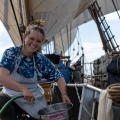

A heavy tropical downpour greeted us at 05.30 am on our first morning in the Galapagos archipelago. We were on San Cristobal and needed an early start for the expedition to Española island. As the rain drenched the land, we prepared for the day at sea. Thankful that the skies cleared just as we emerged from our slumber, we made our way to the meeting point.
It was a Sunday morning, and San Cristobal was sleepy- a stark contrast to the buzz of Saturday night- small groups on the street late into the night, conversations fueled by the world cup.
At the waterfront, we met with Lorenzo, our guide for the day. A short water taxi took us to our tour boat where we were welcomed with an array of fresh fruit, yoghurt, granola, and pastries.
What proceeded was a four-hour jolting ride through the infamously choppy Galapagos waters. By now well acquainted with the roll of the sea, we kept our colour, but lost a little dignity stumbling around in the motions of an unfamiliar craft.
The waters between San Cristobal and Española introduced us to our first waved albatoss. Dark and cream, yellow and angular, it wheeled through the swell. I was reminded of Melville's portrayal of Ishmael first sighting an albatross in Moby Dick- deep in the Southern Ocean. 'Through its inexpressible, strange eyes, methought I peeped to secrets which took hold of God.'. Ishmael's polar circumstances were entirely unfamiliar to where we were now, within 1.5 degrees of the equator, lathered in sunscreen. The awe of the occasion, however, matched.


We were also met by Galapagos petrels and shearwaters, and persued by Elliott's and wedge-rumped storm petrels. These families of birds that Europa is used to seeing in the chaos of the Drake have been uncannily translated to the tropics. A Pacific green turtle dipped below the swell, and, at one point, the iconic fin of a reef shark cruised past. Lapping up these encounters eagerly as Española island encroached on the horizon, we were restless to arrive and explore a new environment.
After anchoring, hopping into a rib and skimming between the swell to the sheltered landing site, we were faced with our first Christmas iguanas. Conveniently marketed, these endemic marine iguanas turn red and green during the mating season, which happens to coincide with our festive celebrations. Today, these Jurassic reptiles lounged on the rocks, speckled with the remnant reds and greens of last Christmas' activities. There was only time to stop for a brief photo, however, as the surf sloshed towards us over the rocks, and we were forced to dart inland for shelter.
Here, dainty lava lizards clambered over the unbothered iguanas, grooming parasites off their large relatives. Española mockingbirds hopped through the coral shingle at our feet, peering up at us with heads tilted expectantly. We made our way from the white sands into shrubland, where medium ground finches and Galapagos doves allowed us only glimpses as they stealthily navigated the vegetation. Of all the archipelago's animals that Darwin ate, he said these doves were the most delicious. Galapagos hawks were silhouetted above, casting ominous shadows against the power of the sun.
The path opened out to a colony of Nazca boobies. These divers- with whom we were by now well acquainted both through reading and practical experience from our guano filled hitchikers- are renowned for their cutthroat lifestyles. To survive, every booby must start life with an act of siblicide. For them, it is kill or be killed.


Waves below crashed at the rocky coastline of the islands southern side. Exposed to the south east trade winds and swell of the Humboldt current, the land is slowly softened to water. An impressive blowhole periodically erupted, and Lorenzo joked that this was the only place in the world where you could see a flying iguana. A red-billed tropicbird circled continuously in the updraft where offshore winds met the short cliffs. Despite stumbling in the gusts, the white bird remained in a regal dance with its tail steamers adrift.
Rounding a corner, we sighted a Galapagos hawk on her nest, partner silhouetted in background. On other islands, females are assisted in raising their clutch by up to four males, but here the feeding grounds are productive enough for a more conventional partnership to suffice in sustaining chicks. They are the only terrestrial predators of the island, the whole ecosystem held in the tight grip of their powerful talons.
The highlight of the island, and main reason for our visit, however, are the nesting waved albatrosses.
Resting, preening, nibbling one another in pair bonding behaviour, they were unbothered by our presence. Big, dark eyes- framed by a protruding supercilium (goofy little eyebrow), lazily observed the goings on. Behind us, some formed a raft in the sea to feed on squid. Above us, they soared between hawks and the sky, wings drawn back in a cupid's bow. In front of us, they slept throught the heat of the day.
On our way back, we pass Galapagos sea lions lazing across the shore line. Fluffy and brown on the high end of the beach, they cuddled into the shade, sleek and dark near the water, they were peppered with sand.
We return to our boat for lunch before a refreshing snorkel. Then, it is time to turn back to San Cristobal, where we will meet with our fellow crew who went on snorkeling excursions to Kicker Rock and Tijeretas Playa. We enjoy a quiet evening of sharing stories from the day before returning to our bunkies aboard Europa, imaginations full of reptiles, birds, and fish, eager for tomorrow's unfoldings.
