

The Voyage to Galapagos
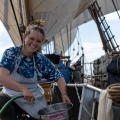

After five days at sea, we are settling into a life defined by the rhythm of the wind and waves, irrespective of the trappings of daylight and sleep schedules. Terms like ‘sheet’, ‘clew’, ‘haul away’ and ‘hold’ are gaining familiarity, the world of tall ship sailing is unfurling. Mastery of this art takes a lifetime, but what we are beginning to grasp what it takes to move a technology like this.
We are in the space between, minds no longer land-locked, but still with room to learn the secrets of the seas. Over time, wind, waves, ship, and sail will become familiar, combining to take us on a journey of connection between each sailor and the ocean, the mythical Europa, and our fellow crewmates.


We think of those that first made the journey from South America to Galapagos, discovering dark volcanoes forced through the crust of the earth by convection currents of churning molten rock. First the lichens, spores adrift on trade winds, settling on the harsh landscape and, in their survival, secreting acids that carved fine pores into the bare rock. This allowed lava cacti to take hold, a species which sheds its own flesh to create a hummus from which to draw moisture. Then came herbs like mollugo, ancestral seeds transported by wind and in the guts of birds, over time differentiating from their predecessor and becoming a species of their own.
As the flora colonised the space, seabirds landed for much needed rest, bringing with them guano, packed with the nutrients of the deep. Sea life flourished around the islands, mountains forcing abyssal currents to churn nutrients from the seabed to the photic zone where life could consume them. Then came the reptiles. Rafting on driftwood, iguanas rode the Panama current, many lost at sea, but a few landing on the Galapagos archipelago. A mystery here is raised, as DNA tests show that the marine iguana speciated before the islands we know formed. The Galapagos first discovered by the iguanas has by now eroded back into the sea, remaining only as underwater seamounts, and echo of the proud protrusions that once sustained such life. Only by island hopping have these creatures persisted. It was much later that humans arrived, five hundred years ago, desperately stumbling upon islands bursting with life while lost at sea themselves. But that is a story for another time.


In the past days we have seen both skysails and stunsails set, and we are bending on the outer jib. Europa dressed in all her skirts, proudly rigged for the trade winds, a far cry from the battles with the Drake with which she is so accustomed.
Boobies tousle for space in the rigging, just as their ancestors jostled one another aboard the Beagle. With us, they enjoy an easy ride. Yards of wood, pulled deep from the forests of North America, form perching spots, a welcome break in the endless brine. Steel hull parts swell that has been building over hundreds of miles, Europa’s cold belly sends flying fish skitting between the waves. This is what the boobies were waiting for. A meal served on a platter, packed full of polar nutrients and the energy of the tropical sun. They lazily swoop in to guzzle the silver snack. By the time they return to the yard, their space is filled and the booby is met with slashing bills and unwelcoming squawks.
At night, an eerie clicking echoes across the decks. What some presumed were dolphins turn out to be swallow tailed gulls. The only nocturnal gull species in the world, these saucer-eyed birds of the night create sounds for reasons which evade us. Scientists postulate that they are echo locating, but with no empirical evidence, we are left to question their motives. While we have come a long way from the times of our scientific ancestors, many questions remain unanswered.
This is how we continue our voyage from Peru to Galapagos, adorned in canvas, accompanied by hitchhikers, in eager anticipation of what the islands have in store for us. We are certainly not the first to have an experience like this.

