

Deception Island

Whalers Bay and Telefon Bay
The large passage between the South Shetland Islands and the Antarctic Peninsula, the Bransfield Strait, experienced its first episodes of vulcanism dating all the way back to 25 million years ago. Eruptions, lava flows, and intrusions that repeated on many occasions since then, with activity peaks about 10 and 3 to 4 Million years ago. Those episodes are the ones that gradually built the mighty volcano of Deception Island. Not long ago, just about 10.000 years ago, this large volcanic building collapsed, becoming since then a flooded caldera.
A peculiar island that was first discovered very close to the date when Antarctic lands were sighted for the first time.

The name, Nathaniel Palmer, the date 15th November 1820, and the ship the “Hero”. Deception was found when she departed southwards from the main sealing harbours at the time, an area located between Livingston and Smith Islands.
He headed South and West and soon saw an island that, oddly, had less snow on it than its neighbours. He made his way along its eastern shore which was straight as a ruler but too rugged to land. At the southern end was the massive bluff of Bailey Head and beneath it a beach which, even today, in tough inflatable powerboats, is a trophy landing.
The afternoon of 15 November 1820 was not a fine day. Snow was blowing up into a storm. Palmer felt his way down the coast and, at 20:00, finding no shelter, he stood off to ride out the night. At five next morning, he continued to where the cliffs had a bite out of them, before they reared up again in gigantic cliffs teeming with pentad petrels with irregular white flecks over the wings like paint spills. In mid-morning a slot-like gap opened in the coast and turned to starboard, rust-red rocks to his left. instead of ending inn a gully where one or perhaps two small ships might take precarious shelter, he found he had sailed into one of the world’s great natural harbours, up to five miles across. It is shaped like a horseshoe that has bent almost wholly closed.
He named the entrance Neptune’s Bellows, and the island whose shape had fooled him Deception Island. In thick weather he went ashore and climbed the south facing crags to the bite in the cliffs, and named it Neptune’s Window. Mobbed by petrels, he collected eggs and trained his superb eyes one the south and east. On the horizon he saw land. Soon he would sail there and find land which proved to be the Antarctic mainland
John Harrison. “Forgotten Footprints. Lost Stories in the Discovery of Antarctica”
After the Hero found the narrow entrance to enter the island’s caldera, the crew landed at a bay just around the corner. From there, Palmer took a short hike to a distinctive saddle up the steep cliffs. In a day with such good visibility as he had, he could see glaciers and snowy mountains on the southern horizon. He just spotted the Antarctic Peninsula.
Not known to him, and neither to anyone else out of these waters, 10 months before, first the Russian Fabian von Bellingshausen, then just three days later Edward Bransfield, both had also sighted the mainland. In that short period of time, the three expeditions have discovered the so far hypothetical and mythical Terra Incognita Australis. A quest for Antarctica that had defeated the great Captain James Cook, who ventured into these southern latitudes 45 years before in search of these lands.
For us, it was just in the early morning when we went through Neptune’s Bellows. Southwesterly wind blows at about 20kn, and the low clouds hang over the hills that surround the island. We leave at Starboardside the high orange cliffs of Cathedral Craggs, while on port lies the submerged hazard of Raven’s rock. A short but intense passage, leading to the natural large harbour of Port Foster.

The first thing to catch our eyes are the remains of a whaling station. The Norwegian Hector, built in 1912. Nowadays, many of its structures and buildings barely stand, left behind for nature to take over again, after many years of use for different purposes.
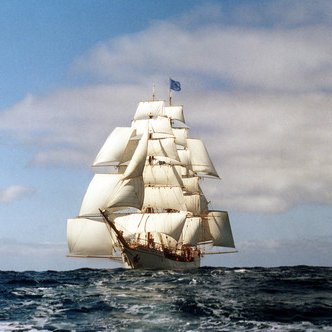
Soon after, with the Europa adrift, the zodiacs brought us ashore. There, we all first gain a bit of height as we walk to the very same area from where more than 200 years ago, Nathaniel Palmer saw the Antarctic Peninsula. Today, the coming and going fog and the low cloud cover didn’t allow for the same view, but nevertheless an impressive viewpoint over the Bransfield Strait.
Walking down the hills, the next goal was to spend some time wandering about the whaling station.
It was 90 years after the island was discovered when the whaling at a commercial scale begun here, and it worked until 1931. By the end of this period, the first ever flight in Antarctica took off from the flats above the beach, on the 16th November 1928. Standing today at the beach still stands the large hangar where the plane was sheltered, which many of us paid a visit to.
Remains of those times can be found scattered al along the bay. Sure, stand out the large oil tanks and some of the boilers to render the oil. Old sloops lay at the shore next to what is left of boat sheds, barrels, and several buildings. The latter ones were used even for longer than the operational time of the whaling base. After its closure, they were home for the English “Operation Tabarin” during the Second World War, with the top secret task of monitoring any possible German Naval communications in the South Atlantic and Southern Ocean. Then, the Falkland Islands Dependencies Survey (FIDS), the former British Antarctic Survey, used the buildings, now for scientific purposes.


Once our time ashore was over, it was time to board the Europa and head towards our next landing site.
The rest of the day was to be spent still inside Port Foster. The next spot to visit in Deception was on the northern side of the caldera. Europa dropped anchor in front of the so-called Gonzalez Harbour, and we all helped ready everything for the afternoon hikes over the barren volcanic landscape of Telefon Bay. A name that comes from a vessel that used this bay for repairs, and her name was applied to this area already in the chart drawn by Jean Baptiste Charcot after his expedition in 1908-10.
Low clouds are still clinging on the higher areas, the fog drifts now allowing for a bit of visibility now veiling it completely. Nevertheless, it was still possible to see several of Deception’s secondary craters, some flooded by the sea. The boats drive straight away into one of them, Gonzalez Harbour. Named in honour of Prof. Oscar Gonzalez-Ferran, author of several important papers on the evolution of the Deception Island volcano.
Almost no vegetation at all has grown yet over the geologically relatively recent volcanic scenery. Small shallow bays and meltwater lakes are to be seen here and there from the different heights where we climbed when we split into two groups. Due to the amount of minerals that the water contains, it is slightly above the average temperature of Antarctica, and the algae communities that develop in it, their colour is of a beautiful green-emerald-blue.
The most challenging walk this afternoon, we hiked up to the top of the highest volcanic cone around, Cross Hill. Named in 1954 by the Falkland Islands Dependencies Survey because at that time, a large wooden cross erected by the whalers was at its summit. Nowadays, nothing is left of it, and at its top we can just see a small rock cairn.
With the cloud cover falling to the sea level, it was time to leave the landing after our nice hikes and head back to the ship. Soon she heaves her anchor and heads off Deception, motoring her way southwards across the Bransfield Strait.
