

Gerlache Strait

Graham Passage. Wilhelmina Bay. One Harbour. Errera Channel.
An overcast morning develops into a sunnier day along the western shores of the Antarctic Peninsula. In the early hours, the ship aims for the entrance of the relatively narrow and glaciated Graham Passage, a scenic waterway between Bluff Island and the mainland at the West coast of Graham Land. It leads to the Gerlache Strait, and from there, the next bay we visit is Wilhelmina.

The high mountains of the Antarctic Peninsula, all covered under a thick blanket of glaciers, frame this 15nm embayment. Its waters are often feeding grounds for numerous Humpback whales, and the calm seas, windless situation, and sunny weather made for the perfect whale watching morning. Their blows can be spotted here and there at a distance, on a few occasions, an individual or two surfaces close to the ship, showing their flukes as they repeatedly dive deep.


The Humpback whales that travel here, to the western shores of the Antarctic Peninsula at this time of year, come from their breeding areas all the way in Colombia, Costa Rica, and even Panama. They do it to feed in these rich Antarctic waters before starting their long migration northwards as the cold, icy, and dark winter comes to these latitudes.
Slowly, the striking small bay of Orne Harbour comes to sight, nestled amongst the calving glacier fronts and steep peaks of the so-called Arctowsky Peninsula, mainland Antarctica.
Landing at the steep rocks at the coastline, a relatively steep snowfield, where a clearly visible path zigzags, brings us to a high saddle. All the way up there, amongst the rocky outcrops, a small rookery of Chinstrap penguins can be found. A species that often prefers steep and long hikes to reach their nesting grounds, here they have quite a climb along some of their well-trodden highways that run from the coast far down below. Following the rocky ridge, towers above us the 285-meter-high Spigot Peak.


The weather holds well, allowing us to enjoy a fantastic panorama from up this saddle, one of the most impressive views over the Gerlache Strait, Anvers and Bravant Islands. The large Ronge Island looks quite imposing too in front of us with its tall mountains and glaciers. Between Ronge and the mainland extends the Errera Channel with its Couverville and Danco Islands.
After enjoying such a privileged view, we come down the hills and re-embark the ship. It's still early in the afternoon, and we have a bit of time for conducting yet another of the Citizen Science projects. Fjord Phyto. This is a joint endeavour between phytoplankton ecologists and ocean biogeochemists at Scripps Institution of Oceanography in California and the National University of La Plata in Argentina, and is designed to investigate how the phytoplankton communities that form the base of the Southern Ocean food web are changing in response to freshwater input from melting glaciers. It is based on taking phytoplankton samples by towing a net behind the zodiac, checking the visibility in the water column by lowering a Secchi disk and profile Temperature/salinity/chlorophyll to 100m deep using the oceanographic instrument called CTD.
A handful of Voyage Crew, plus our two guides, set up the necessary equipment and launched a zodiac to work on this for about an hour.
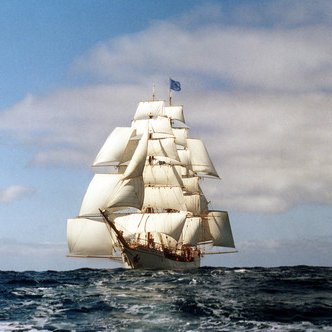
Back aboard for dinner, the Europa heads now for the ship’s cruising the very same channel we had a glimpse of from our afternoon landing site, the Errera. The scenery is outstanding, the evening light beautiful. The calm waters reflect all the surroundings, mountains and glaciers from the mainland and the few islands that are in this waterway. Numerous large icebergs lie here too, the ship approaches them and sails by in a great evening cruise.