

Landing at Yalour Island and Zodiac cruising Berthelot Islands in Collins Bay.

Sleepy faces show up for breakfast, and on deck, and at 08:00h, the zodiacs are readied for a landing.
The ship has been drifting in opener waters next to the Argentine Islands for the night, and now she is at the shores of Yalour, a little archipelago located in the shadow of the headland Cape Tuxen. A conspicuous and impressive vertical rock cliff which has seen the most famous stories in the past. It was here that Charcot, during his first expedition (1903-04), took the honour of setting foot on the mainland west coast of the Antarctic Peninsula for the first time. He returned to this very same spot during his second expedition (1908–10) with the bad luck of running his ship aground, the Pourquois Pas?. Charcot continued his explorations further south without letting the crew know the real extent of the damage. A dangerous business that nevertheless worked out well, as afterwards they still overwintered at the neighbour Peteman Island, and afterwards they could return safely to South America.
You secretly find out that your keel had been badly damaged by hitting a rock. Do you accept defeat and turn for home, or do you conceal the truth from friends and colleagues and sail back into the ice and uncharted waters that holed her?
Jean Baptiste Charcot
The islands where we landed this morning, with the famed cape in the background, and home for an Adelie penguin rookery, were named by him after Lieutenant Jorge Yalour, of the Argentine Navy. He was an officer of the Argentine corvette Uruguay, which came to the rescue of the shipwrecked Swedish Antarctic Expedition in November 1903 in the Weddell Sea.
Low-lying hills with rounded tops stick out of the snow cover. Small groups of nesting Adelies find their places atop them. We had to sail all the way here, south of the 65º, to find this truly Antarctic species of penguin. They need cold waters and icy conditions, which on the west side of the Antarctic Peninsula are found from this latitude southwards.

And here they enjoy an enviable location and magnificent surroundings. The views on a day like today, with good visibility and sun peering through the high clouds, are of the most picturesque character. The large glacier fronts and high mountains from the mainland frame the eastern area of our view. To the south, the view is crowded with enormous icebergs; smaller ones pepper the waters from here to the Argentine Islands and the channels between Yalour islets.
A biological limiting area for the Adelies, an area where huge bergs run aground and also a latitude that tells us more about the history of mapping and discovery of this part of the White Continent. Northwards, the lands explored by Gerlache during his Belgium Antarctic Expedition (1897-99), to the south, all the way over the 70ºS, Jean Baptiste Charcot's territory.
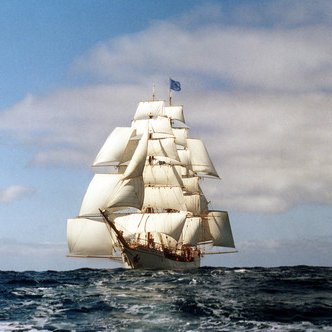
And a bit further south, we head after our morning visit to Yalour and its penguin rookery. Now the ship heads towards the next group of islands that can be seen at a distance, half hidden by icebergs and brash ice-covered waters. Slow progress for the Europa, after lunch, she brought us to the shores of the Berthelot Islands.


The high alpine peaks of Graham Land shine in the background, with their large glaciers tumbling down to the sea. Between them and the islets, a maze of icebergs shines under the sunny weather. A panorama of truly Antarctic atmosphere, a desolate and striking setting, a perfect area for a farewell to Antarctica. This evening, we are heading off to the Drake Passage. But before that, we had time to enjoy a last activity in Antarctica, zodiacs and the sloop are lowered in the water for cruising with all of us. Open water channels are around the islands, and a bit offshore, it is ice all we can see, ice loose enough though for allowing a challenging cruising, and where Crabeater seals snooze under the sun.
In the background, the mighty Trooz Glacier. Its vertical tidewater front reaches about 100 meters in some areas and can calve monumental icebergs. Sure, some of them are the ones that fill up the waters where we cruised this afternoon. A scenic and breathtaking cruise under unbeatable sunny weather and still conditions, over the mirroring waters of Collins Bay.
Back on board, it all goes fast. Dinner first, and then straight away the beginning of the sea-watches. We go back to sea.
Safety lines are readied, safety nets tied up. It will take a while still until the ship manoeuvres amongst shallows and Icebergs to reach first the French Passage, which eventually will lead us to the open oceanic waters. But with the forecasted Southwesterly wind, it is now time to unfurl some sails, which will hang on their gear until they can be set once there.
