

Last day on the Drake Passage
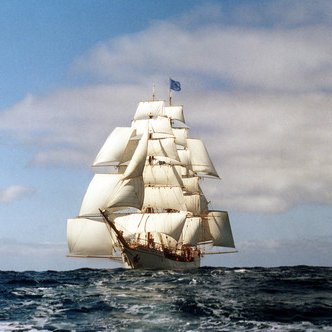

A journey of calmer winds and seas. Motorsailing our way to Antarctica.
Right at the beginning of the new day and with it the new year 2026, the first thing we hear is the engines roaring. The next is gathering on deck the ones on watch shortly after midnight to douse the Main Course. What a different and stimulating New Year’s Eve we had, surrounded by the open waters of the Drake Passage and pulling the sail bunts and clews just before waking up the new shift that will be on for the next four hours.
Yesterday we had an exceptional sailing day, but as it got late at night, the wind died down together with the calming seas. From a good Southwesterly up to 30kn, now it has decreased to about 15kn, and with it comes a drop too in our speed.
We will need a bit of a push from the motors to keep a good average, not to be too late on our arrival to the Antarctic Peninsula.

The rest of the square sails are still set until about breakfast time, when the moment arrives to strike them and keep motorsailing under Lower and Middle Staysails and headrig.
For the ones that are up to it, the first morning of the year begins with a climb up the rig to furl Royals and Courses.
Later on, the wind becomes Easterly, making it necessary to pass the staysails to the opposite tack. The combination along the Drake Passage of motor sailing and some proper sailing as well has brought us 150nm closer to Antarctica during the last 24 hours, having left behind already 510nm since we departed from Ushuaia.
A look at the bridge GPS also tell us that we left behind the latitude of the Furious 50´s, now venturing into the so called Shrieking 60’s. But today, not much of its famous screaming winds blow. Actually, the conditions abated, and the ship has steadied her rolling and heeling. Lucky us, because today is the last bit of time we have to get ready for the upcoming time we are to spend in Antarctica.

One of the most important preparations before we can do any activity ashore is to conduct the mandatory Biosecurity Procedures to minimise the risk of introducing to such a unique environment any seeds, organic material, dirt that we may bring on our clothing and backpacks from other areas in the world. Measures that nowadays are more important than ever due to the recent outbreaks of HPAI (High Pathogenic Avian Influenza) that have resulted in the death of hundreds of thousands of seabirds around the planet.
Once this is done, we are ready for our visits ashore. First, we plan to visit the South Shetland Islands, the first Antarctic lands to be discovered, which didn’t happen until as recently as 1819. By late night or tomorrow early morning Europa should be arriving in this very same area, which first saw human presence when William Smith was blown out a very long way southwards from his rounding of The Horn on his trading voyages.
We steer now towards the English Strait between Robert and Greenwich Islands, planning for a morning landing at Fort Point, the easternmost cape of the latter.

Still in the high seas, this first day of the year (as the last one we spent in the high seas before reaching land) is when we do our last seabird surveys for the moment. Today, Cape petrels show up, Prions, White-chinned and Storm petrels, and a couple of Black-browed albatrosses flying a bit further south than their usual foraging grounds. But it is not until late in the evening that we spot one of the most elegant of the albatrosses, a beautiful Light-mantled. With their black and grey suit and stylish soaring often they can often be seen further south than other albatrosses, and even some individuals now and then are spotted near the edge of the Antarctic pack ice.
