

Sailing the Drake
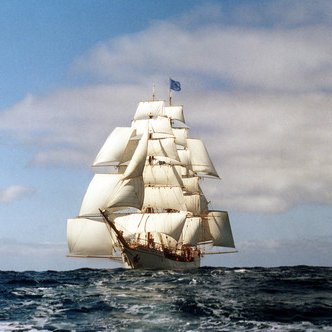

Last day of the year offered great sailing along the Drake Passage and crossing the Antarctic Convergence Area.
The last day of the year, a good journey of sailing in the Drake Passage and on such a special day as today, we sail into the cold Antarctic waters.

It was in 1911 when the German scientific expedition led by Wilhelm Filchner on board the ship “Deutschland” sailed deeper into the Weddell Sea than anybody before. They discovered new lands, they worked on meteorological, geological, and oceanographical observations. The oceanographer on board, Brennecke, made one of the most significant discoveries of the expedition, he measured and described the four isolated water masses in the Southern Ocean, including the finding of a sudden change in the salinity of surface waters flowing north, and an associated steep temperature plunge. 114 years ago, he just had found a consistent boundary between the Subantarctic and Antarctic worlds, the nowadays known as the Antarctic Convergence Area or Polar Front.
As we sail south ourselves, we can easily measure this meeting of the two water masses. The readings of the thermometer over the surface water drop from 6.3º C at 4:00 in the morning to 3.8º at 16:00h, a steep change that affects the air temperature, which plunges too from 6º C to 4.8º C during the same time frame. We just crossed this Polar Front, and now we can say we sail in the Antarctic system.

And indeed, good sailing we had for the whole day. In the morning we wake up under the same sail configuration that we had last night, while the Southwesterly wind is less gusty though still blowing between 25 to 30kn, with some peaks up to 35kn. Sailing Close-Hauled on a SSE course and growing seas, the ship heels to Port side now instead of the more rolling situation we experienced for most of yesterday. Which makes everybody pay more attention when moving and walking around, though after a couple of days at sea, everyone seems to be getting gradually used to the ship’s motion, and more people show up for their watches, meals, talks, and meetings.
The wind blows more steadily from mid morning onwards, around 20 to 25kn, allowing to set more sail to keep a good speed. Hands are called on deck to hoist Top Gallants and Outer Jib, and over the Main deck the larger Desmond instead of he small Aap. It is in the afternoon before dinner when the Middle Staysails and Royals are hoisted too as the Southwesterly wind gradually eases down.
Like that, the progress in the last 24 hours towards the South Shetland Islands has been of a good 147 nautical miles.

The overcast and rainy weather has improved too, though colder than yesterday, today we all have a better chance to spend some more time on deck. There we can join our guides while they gather the ones of us interested on identifying and counting the diversity and number of seabirds that can be spotted around the ship. Observations framed in the Citizen Science projects on which the Europa is taking part of. This collective is a community created to bring opportunities for research and public education by connecting scientists and research institutes with tour operators in the polar regions. The large amount of Touristic Expedition vessels visiting those remote waters of the Southern Ocean offer a great chance to engage as much people as possible in data collection to share with them.
As we are now in the rich waters of the Polar Front, the mixing zone between Sub Antarctic and Antarctic water masses, the number of seabirds spotted and the diversity of species has changed from the what we have seen since the beginning of our trip. New birds come into sight flying around the Europa, like Antarctic prions, White Chinned, Wilson, Black bellied and Cape petrels. Others are the same since the Beagle Channel, Southern Giant petrels and Black browed albatrosses.

