

South Shetland Islands

Landings at Fort Point (Greenwich Island) and Half Moon Island (Mc. Farlane Strait)
It is by the early morning when the rocky islets and islands at the entrance of the English Strait come into sight. Now that the Drake Passage is definitely behind us, as we reach the South Shetland Islands, the area for our first Antarctic visits.
Soon, the ship comes across the first of the icebergs on our trip. A nicely shaped one where some penguins rest.

To get to our planned first landing site, the ship first motors her way passing by the so-called Three Piglets, Chaos reef, Cheshire Rock, Asses Ears, Burro Peaks, Fort William, Monica, Passage, and Bowler Rocks. At her Port side, Robert Island, at her Starboard the spectacular glaciers of Greenwich. The very same area to be first seen and trodden by the merchant William Smith and his crew in the years 1819 and 1820. By then, remote and solitary lands were still to be discovered. Nowadays, still inhospitable and off most of the beaten tracks.
We head towards the easternmost cape of Greenwich Island, Fort Point, a low-lying isthmus extending into the temperamental Bransfield Strait. A picturesque location framed by jagged cliffs at its end and glacier fronts at its opposite side, from the ice-cap that covers most of the island. The headland has the appearance of a fortress, hence its name of Fort Point.
Before we had our breakfast, the anchor dropped for the first time on our trip. Tackles are prepared straight away to lower the zodiacs, readying everything for our shuttles ashore. We are here, we have arrived after a few days of sailing adventures in the Drake Passage.
The spectacular scenery and its most notorious inhabitants (the ubiquitous penguins) can already be seen, enjoyed, and smelled from our decks.
Gentoo penguins are increasing their populations in the South Shetlands and North Antarctic Peninsula, where they extend their rookeries over the easy and flat ground. Nowadays, notoriously dwindling in numbers, a small colony of Chinstraps above them and higher up the slopes.


We start our time in Antarctica with the best that South Shetlands offer: wild and harsh scenery, sheer cliffs, calving glacier fronts, a short hike over boulder beaches and up an ice field, swell and surge at its rocky shores, and plenty of its charismatic wildlife.
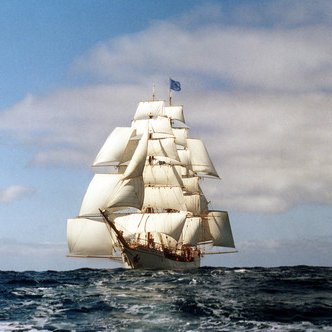
An adventurous boarding of the zodiacs amongst the swells and surges at the beach soon follows by the ship starting her way again, heading for the next place to visit. Rounding southwards the tip of Greenwich Island, the spectacular Livingston Island comes into sight. The Europa enters the eastern mouth of the Mc Farlane Strait on her way to the Crescent-shaped island of Half Moon. Here the seas are flat, the temperature low and the wind is relatively calm, good conditions for another of our landings.
Right next to where the zodiac dropped us ashore lay the remains of an old dory, dating back to the beginning of the 19th century. Left behind by then, she slowly falls and acts as a witness of those past whaling times in the area. It was not just the whalers who worked here, even before them, dating back to 1821, sealers seek for the Fur seal pelts and the blubber from seals.
Amongst Chinstrap penguin rookeries, some of those remains can be found. At the other end of the beach, yet another feature of the island stands out, the more modern Argentinean Base Teniente Camara, built in 1953.
More in use in the past, nowadays it is barely occupied, and its Antarctic Program, when there are no scientists working here, takes care of its maintenance. That is where we head to have a quick look at the locked-up buildings and to call the zodiacs to board the ship again. As soon as we are all aboard, the anchor is heaved while we hoist the zodiacs on deck and the Europa starts her way south along the coasts of Livingston Island. The next destination is Deception Island.
Soon, strong headwinds hit us together with a growing, steep, short swell, which made for slow progress. It will take until tomorrow morning to reach the volcanic caldera of Deception Island. But for now, venturing out to a windswept deck, we can enjoy our first beautiful Antarctic sunset over the astounding mountainous scenery of the South Shetland Islands.