

Starting our way along the Beagle Channel.
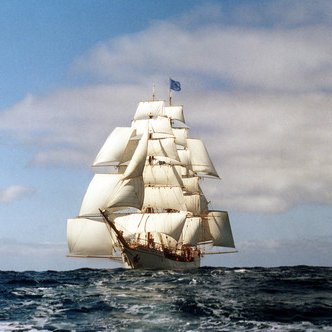

Beginning of our Antarctic journey across the Drake Passage. After a good night at anchor, for a welcomed change, Ushuaia wakes up today under good weather, calm sea conditions, and light winds, though they blow from an uncommon east direction, while the predominant situation is usually a stronger westerly wind.
This was the day our adventure to Antarctica began. During breakfast, the mandatory Pilot for the inshore waters of the Beagle Channel boards the ship, while Europa heaves anchor and starts her engines, soon leaving behind the busy city harbour.
Time now for the mandatory Safety Drill to be done prior to departure on any sea voyage on a ship. The conditions are as good as they get in this part of the world, and before any unexpected change, we first take the chance to start straight away with the excitement of the climbing aloft instructions.
The rest of the day builds up with more familiarisations of the ship, her rig, lines, sails, and the crew coaching for two of the important duties that we are asked for during the sailing part of the trip, steering and conducting a good lookout.


All along the relatively calm waters of the Beagle, the channel between the Atlantic and the Pacific Oceans, south of the Straits of Magellan, named after the surveying and charting ventures of the famous ship HMS Beagle in the 18-hundreds. Following her first trip in the area (1826-30) under the command of Captain Pringle Stokes, she was handed over to Robert Fitzroy, who, in the ship’s most famous second exploration voyage (1831-36), brought along the man who was about to change the way we think about the natural world, Charles Darwin. Nowadays, the channel plays a political role since 1881 when it was decided that it will represent the southern border between Chile and Argentina. And so it goes, the Chilean lands, peaks, and forests lay at our Starboardside, while at Port the Argentinean southernmost shores of Patagonia extend.

In the afternoon, the ship already is already approaching the end of this waterway, time for waving a “see you” to our pilot and his assistant, and start setting some sail.
We start then to get acquainted with the rope-maze that hangs from the rig. Today, an unavoidable mystery of countless lines to ease and pull, but soon, with the help of the crew, we gradually will solve the puzzle.
We gather on deck to set first the canvas on the Fore Mast and Bowsprit. Topsails, Course, and Top Gallants are sheeted down and hoisted. Inner and Outer jibs are pulled up too.
Afterwards, the same sails in the Main mast follow, together with Lower staysails and Spanker.
By then, we are still sailing at the lee shore of the Wollaston Archipelago, which includes the various islands and islets between Navarino and Cape Horn, just about to enter the famed Drake Passage. About 500nm of treacherous waters that run between South America and Antarctica through the legendary latitudes of the Furious 50’s and the Screaming 60’s.
Its name and character pay tribute to the feared privateer Sir Francis Drake, a celebrity from the seven seas during the 16th century.
At night, the wind quickly picks up, the relatively distant Cape Horn kicks with squalls and strong gusts that make for reducing canvas. Top Gallans and Outer Jib are clewed up and furled. But soon the wind decreases and shifts to an inconvenient South-southwesterly. At the wheel, we try to steer southwards, but the ship is pushed eastwards by the wind and leeway current.
